
 Presenting the laser scan as a “walk through” raises options of viewership (human? squirrel? spider?) and related issues around range of sight and resolution that consequentially can begin to approximate experience. Or create a new experience…
L-Systems

There are a number of different ways in which one can produce a model of a tree, and we have explored many of these as a group. One particularly interesting class of “tree model” is the mathematical model. Within this class, there exists a substantial variety of approaches, but the idea, in general, is to replicate tree morphology with an algorithm. I chose to begin my exploration of mathematical trees via L-Systems (named after biologist Aristid Lindenmayer who first proposed them).
L-Systems are a type of recursive string-rewriting system that are capable of, among other things, drawing 2- and 3-D branching patterns. You can read all about them here. Even while remaining totally deterministic, i.e. without introducing probability or randomness, they are capable of producing some pretty convincing plants:

More to come.
bound and unbound
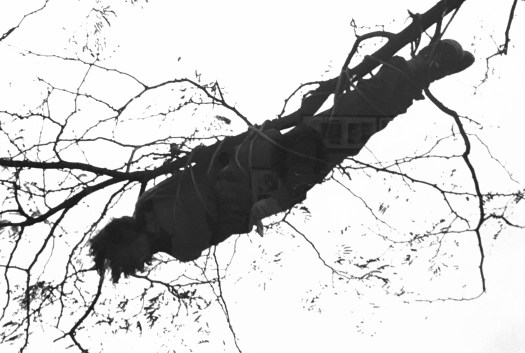
bound and unbound
tethered and untethered
which is the body of mediation—the human form or the tree?
do I project myself into his space,
the binding a cruel act against him—
or is it animal attraction to the tree?
is he free there, suspended against gravity
or am I instead the tree,
possibly imposed upon, bearing this unwieldy thing,
so awkward in its limbs and attitude
do we come to equilibrium,
being neither one way nor the other
Moving through the Allée

A density change through the site 2/13/2017

More rendered points add more details 2/20/2017
Sectionals

From One, to a Quartet

To distill one from many. And then to build back up into a chorus of independent forms.
It looks simple. It looks easy. But it takes painstaking patience to collect the point data, patch and convert the points into a complete cloud, dissect the data into individual tree files, convert those individual tree files to formats that are usable in other programs, import those new tree files, apply animation, render, compose, and finally post.
From the Many, One
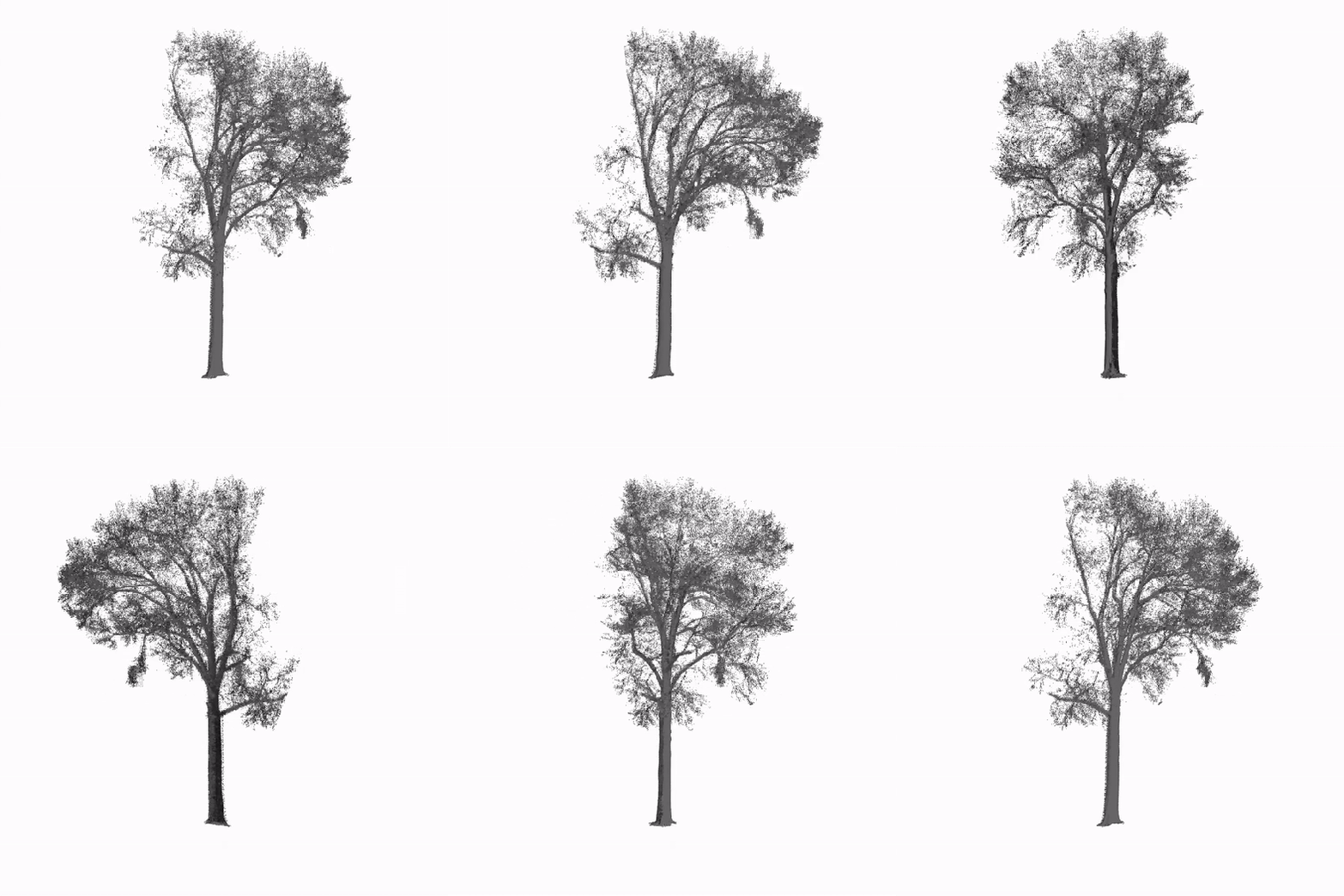
Removed from its community of trees, from the representational perfection of the allee, the oaks begin to emerge as the compromised, asymmetrical, imperfect beings that the always, already have been.
 The One Tree Project